

Buy Original Landscape Photography Prints: 2026 Guide
Table of Contents
- Why Original Landscape Photography Prints Beat Mass-Produced Wall Art
- Fine Art Landscape Photography Prints: What Sets Them Apart
- How to Frame Landscape Photography for Any Space
- Collecting Fine Art Photography: Edition Sizes and Longevity
- What to Check Before You Buy Original Landscape Photography Prints Online
- Matching Landscape Prints to Modern and Minimalist Interiors
- Conclusion
- Frequently Asked Questions
Last Updated: September 19, 2026
Why Original Landscape Photography Prints Beat Mass-Produced Wall Art
Walk through any big-box home store and you will see the same three or four mountain vistas reproduced on thin paper, priced to move. They look fine from ten feet away. Up close, the detail dissolves, the colors are a little plastic, and thousands of other apartments have the exact same image. That sameness is precisely why so many people now search for landscape photography prints that carry a signature, a story, and a real photographer behind them.
At Art By Earth, we shoot impressionistic nature scenes and produce them as frameless canvas wall art, so the work you hang reflects a specific moment outdoors rather than a stock file that gets recycled everywhere.
The sections below walk through materials, framing, and how to verify a seller before you spend. We also cover the questions buyers ask most: is it a real photograph, will it survive a move, and will it fit a minimalist room.
Fine Art Landscape Photography Prints: What Sets Them Apart
Fine art landscape photography prints are images produced by the photographer or an authorized studio on archival materials, with color managed end to end. The photographer controls the file, the paper or substrate, and the final inspection.
A quick way to separate real fine art from decor filler:
- The seller lists dimensions in inches and centimeters
Mass-market wall art rarely answers any of these. That gap is the whole point.
Giclée Printing and Archival-Grade Materials
Giclée printing is a pigment-based inkjet process that sprays microscopic droplets onto archival media, producing smooth gradients and a wide color range. It became the standard for fine art reproduction because pigment inks resist fading far longer than the dye-based inks used in cheap poster runs.
Canvas, Acrylic, and Aluminum Mounting Options
Canvas prints arrive stretched over a wooden frame or rolled, and they suit warm, textured rooms.
Finish |
Look |
Best For |
Care Notes |
|---|---|---|---|
Frameless canvas |
Soft, textured, matte |
Living rooms, bedrooms |
Dust with dry cloth |
Acrylic mount |
Glossy, high contrast |
Modern, minimalist spaces |
Avoid abrasive cleaners |
Aluminum print |
Sleek, flat, rigid |
Kitchens, offices, humid rooms |
Wipe with damp cloth |
Paper print |
Classic, needs framing |
Collectors, custom framing |
Frame behind glass |
For renters, frameless canvas is the practical pick. It hangs without a frame, weighs less, and travels well.
How to Frame Landscape Photography for Any Space
How you frame landscape photography depends on the room, not the print.
A few rules that hold up in practice:
- Leave at least 2-3 inches of wall space around the frame on each side
- Match frame color to the room's hardware, not the artwork
- Hang the center of the piece at eye level, roughly 57-60 inches from the floor
- For a sofa, keep the art 6-10 inches above the backrest
- Group odd numbers together; three small prints beat two large ones
Frameless Canvas and Renter-Friendly Hanging
Frameless canvas solves the renter problem. There is no glass to break in a move, no frame to scratch, and many pieces hang from a single hook or a removable adhesive strip that leaves no hole. For apartment dwellers who cannot repaint or drill freely, that matters.
Collecting Fine Art Photography: Edition Sizes and Longevity
When you evaluate an edition, check three things:
- The stated edition size and how many remain
- Whether the print is signed or comes with a certificate
- Whether the same image is sold in multiple finishes
A common pattern is an edition of 50 at one size and 150 at a smaller size, with the larger size retired first. Ask which sizes share the same edition count, some sellers split editions by size, which changes how scarce any single print really is.
Print Care and Longevity: What Actually Fades a Print
A practical care routine:
- Dust canvas and acrylic with a dry, soft microfiber cloth. Never use paper towels or abrasive pads.
- Rotate pieces seasonally if a wall gets strong daylight. Moving a print twice a year measurably extends its life.
- Keep humidity moderate. Bathrooms and basements with standing moisture encourage mold on paper and canvas.
If you are framing a paper print yourself, ask the framer for UV-filtering glazing and an acid-free mat. Standard glass blocks some UV but not all, and a cheap mat can leach acid into the print over years.
Longevity is not a single label on a listing. It is ink plus substrate plus coating plus where you hang it. Control the last variable and you control most of the outcome.
What to Check Before You Buy Original Landscape Photography Prints Online
Before you buy original landscape photography prints online, verify the seller, not just the image. Screens vary, and a photo that looks vivid on your phone can arrive flatter or warmer in person.
Run this pre-purchase check:
- Is the photographer named and findable?
- Are real dimensions listed in inches and centimeters?
- Does the seller show the print in a real room, not just on white?
That last point separates confident sellers from drop-shippers. A room shot tells you scale and how the colors behave against furniture.
If a listing cannot tell you the photographer, the edition size, and the substrate, it is decor, not a collectible. Buy it because you love the image, not because you expect it to hold value.
Matching Landscape Prints to Modern and Minimalist Interiors
A minimalist room does not need a minimalist photograph. It needs one with a clear focal point and restrained color. Impressionistic nature scenes work well because soft edges and muted palettes read as calm rather than busy.
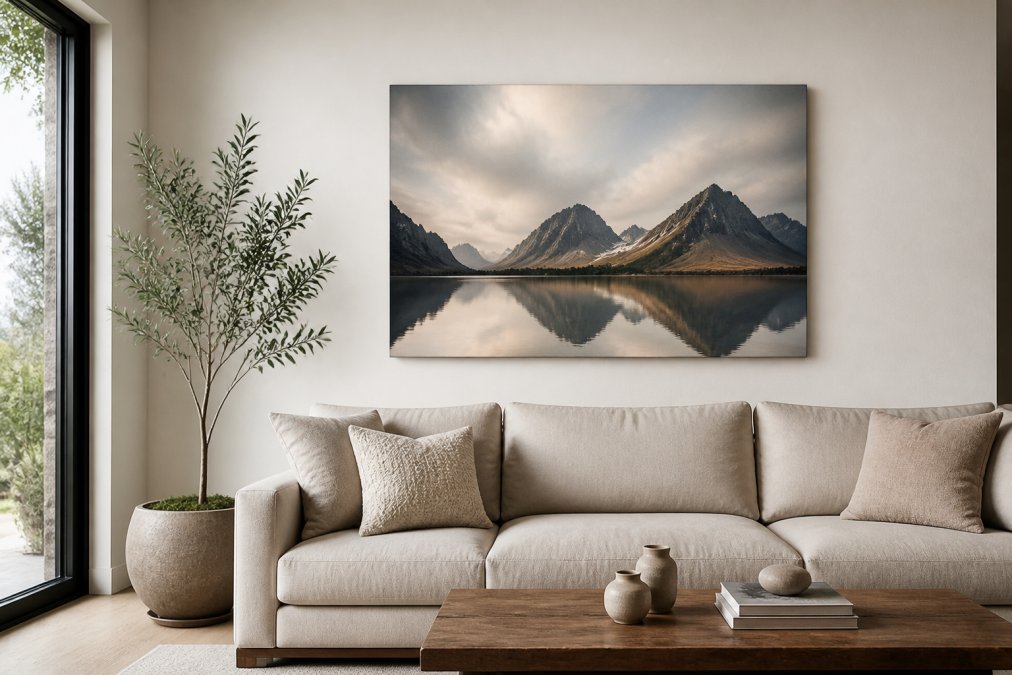
Pair a single large piece with neutral walls for the cleanest look. If you want more than one, keep the frames identical and the color palettes related. A warm seascape next to a cool mountain scene can fight for attention. A forest and a foggy shoreline in the same green-grey family will sit together.
Interior Design Integration: Matching Palette to Light and Wall Color
This is where most buying guides stop short. A print that looks perfect in a gallery can look flat in your living room, and the reason is almost always light and wall color, not the print itself.
Start with the room's light direction:
- North-facing rooms receive cool, indirect light all day. Warm-toned prints, golden-hour fields, desert scenes, autumn forests, balance that cool cast and keep the room from feeling gray.
- South-facing rooms get strong, warm light. Cool-toned prints, misty coastlines, blue-hour mountains, foggy pines, hold their own and prevent the wall from feeling overheated.
- East-facing rooms are bright in the morning and dim by afternoon. Mid-tone prints with balanced color work best because they do not depend on strong light to read.
- West-facing rooms get intense late-day sun. A print with deep contrast and a UV-protective finish handles the glare better than a pale, low-contrast image.
Then match the wall. The goal is contrast, not coordination:
- On white or off-white walls, almost any palette works, but a print with a strong focal color reads best. A muted print on a white wall can disappear.
- On warm beige or greige walls, choose a print with a cool accent, blue water, green foliage, gray stone, to create separation.
- On cool gray or blue-gray walls, choose a print with warm highlights, sunlit rock, amber grasses, warm sand.
- On dark walls, a high-contrast print with bright highlights pops. A low-contrast print will sink into the wall.
A simple test: hold a paint chip or fabric swatch next to the print under the room's actual lighting, not store lighting.
Take a phone photo of your wall in daylight and another at night with the room lights on. Compare them side by side before you buy. The print needs to work in both, not just the one you photographed first.
Conclusion
Choosing art that lasts means asking harder questions than most listings invite. The payoff is a piece that still looks right in ten years, survives a move, and means something because a real photographer stood in that place.
Frequently Asked Questions
How do I know if a photography print is original?
An original print comes directly from the photographer or their authorized gallery, not a stock image with a filter applied. Look for a signed certificate of authenticity, a stated edition size, and details about the capture location. Limited edition landscape photography prints are numbered, which means only a set number exist. If a listing shows the same image across dozens of sellers at wildly different prices, it is likely a mass reproduction rather than an original work.
What is the difference between a fine art print and a standard photo print?
Fine art landscape photography prints are designed for lasting beauty. The difference shows up in color accuracy, surface texture, and how the print holds up over time.
How should I choose landscape photography prints for my home decor?
Start with the room's palette and light. Cool-toned seascapes and mountain photography suit modern, minimalist interiors, while warmer forest scenes pair well with wood furniture and natural textiles. Measure your wall first: a panoramic print needs at least 1.5 times the width of the furniture below it to feel balanced. Order a small test size before committing to a large-format piece if you are unsure how the colors will read in person.
What are the best materials for landscape photography prints?
Archival-grade canvas is a common choice. Canvas resists glare and suits textured, impressionistic work.