

Impressionistic Water Scenes for Peaceful Homes
Table of Contents
- Why Impressionistic Water Scenes Calm a Room
- Calming Water Scene Wall Art: Colors, Light, and Mood
- Impressionist Pond Art and Garden Water Features
- Peaceful Landscape Wall Art for Every Room
- Coastal Villages, Harbors, and River Scenery
- Choosing Scale, Framing, and Canvas Quality
- Caring for Your Impressionistic Water Scenes
- Frequently Asked Questions
Last Updated: October 5, 2026
Why Impressionistic Water Scenes Calm a Room
Impressionistic water scenes for peaceful homes replace hard edges with soft light. Where a photograph pins down every ripple, an impressionist painting dissolves the shoreline into color and lets your eye rest.
A room's visual noise comes from contrast, clutter, and sharp lines. A water scene lowers all three at once.
Water also carries a psychological shortcut. The American Psychological Association's research on nature and stress has documented how natural imagery and environments support attention and reduce stress responses, which is part of why nature imagery in interiors has moved from a trend to a default.
Most buying guides treat "calming art" as a single category. It is not. A pastel dawn over still water and a storm-lit harbor are both impressionistic water scenes, yet they produce completely different rooms.
Calming Water Scene Wall Art: Colors, Light, and Mood
Calming water scene wall art succeeds or fails on palette first. Light and color set the emotional register; subject matter only reinforces it.
Pastel Hues and Soft Reflection
Pastel palettes lower a room's visual temperature. Pink and blue skies, pale greens, and muted greys read as early morning or late evening, the two times of day people describe as peaceful. Warm pastels suit bedrooms and reading corners; cool pastels suit home offices where you want alertness without tension.
One practical rule: match the painting's light source to the room's. A scene lit by evening light belongs where you actually sit in the evening.
Brushwork That Suggests Movement
Loose brushwork separates impressionistic water scenes from generic lake photography. Visible, softened strokes imply rippling water, a breeze, or blurred trees without spelling any of it out. Your eye completes the picture, and that participation is restful in a way a fully resolved image is not.
Impressionist Pond Art and Garden Water Features
Impressionist pond art brings the smallest scale of water into a room. A pond, a garden water feature, or a lily-covered corner of a larger lake gives intimacy without the sweep of a coastline.
Lilies, Reeds, and Shoreline Detail
The details carry this genre: water lilies on the surface, reeds breaking the horizon line, a shoreline of stones or grass. These give the eye somewhere to land, which matters more in small rooms. A pond scene reads well in a hallway, bathroom, or beside a reading chair.
For apartment dwellers, pond and garden scenes are the most flexible choice. They suggest a private outdoor space rather than a vacation destination, which fits urban interiors better than a sweeping ocean view. Smaller unframed canvases also travel easily between rentals.
Peaceful Landscape Wall Art for Every Room
Peaceful landscape wall art should be chosen per room, not per taste alone. The same painting that soothes a bedroom can feel inert in a hallway, and the fix is usually scale and palette rather than a different subject. What most guides skip is what actually decides whether a piece works: how the room is used, when you are in it, and what you look at while there.
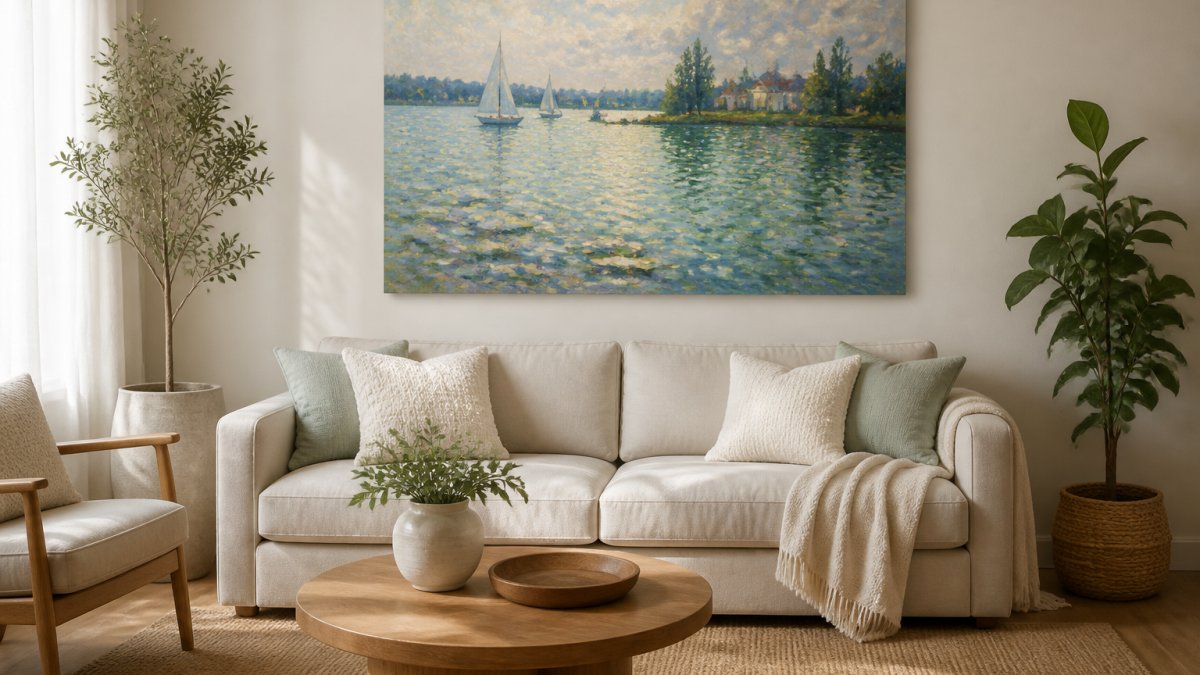
Living Room, Bedroom, and Home Office Placement
Living rooms can handle the widest scenes: coastal villages, harbors, wide river scenery. Place the piece where it anchors the seating arrangement, ideally on the wall you face when you sit down.
Bedrooms reward stillness. Still water, pastel skies, and low contrast belong here; save turbulent water and dramatic sunset color for shared spaces.
Home offices sit between the two. Remote workers tend to want a window substitute, so choose a scene with depth, a receding shoreline or distant hills, and hang it where your camera points during calls.
Hallways and bathrooms are the underused spots. A narrow hallway wants a vertical or square pond scene viewed from a few feet away; a bathroom wants a small piece away from direct steam and splashes.
| Room | Best Water Scene | Palette | Suggested Scale | Placement Note |
|---|---|---|---|---|
| Living room | Harbor, coastal village, wide river | Blue, green, warm neutrals | Largest wall in the seating area | Centered on the sofa, top edge 8-10 in. above the back |
| Bedroom | Still lake, pond, garden water | Pastel pink, blue, soft grey | Medium, centered above the bed | Bottom edge 6-8 in. above the headboard |
| Home office | Receding shoreline, distant hills | Cool blue, lavender, muted green | Medium to large, in camera view | Slightly off-center behind the desk |
| Hallway or bathroom | Pond detail, lilies, reeds | Any soft palette | Small to medium | Short viewing distance; keep away from steam |
Matching the Scene to the Mood You Want
Scene type, light, and water movement set a room's mood more than the frame or wall color. For restful, choose still water with a low horizon and a narrow value range, meaning the lightest and darkest tones sit close together. For airy, choose a high, pale sky and open water, which pushes the eye outward and makes a small room read larger.
A useful test before you buy: describe the scene in three words. If they are calm, soft, and open, it will behave that way on the wall. If they are dramatic, bright, and busy, it will not, no matter how much you like the painting.
Coastal Villages, Harbors, and River Scenery
Coastal villages and harbors add human warmth that pure landscape lacks. Village houses stacked above a wooden dock, anchored boats, a harbor at evening light: these give a room a sense of place without feeling like someone else's vacation photo.
Water's Whisper - Unique Frameless Canvas Wall Art →
River scenery works differently. A river implies movement through a landscape, which suits long horizontal walls and open-plan spaces where a square canvas would feel static.
One caution with harbor scenes: boats and buildings introduce straight lines that can clash in a very minimalist room. Choose a scene where the architecture is softened by distance or haze, and the piece will sit comfortably beside clean modern furniture.
Choosing Scale, Framing, and Canvas Quality
Scale is the most common mistake in hanging water scenes. A small canvas on a large wall reads as an afterthought no matter how good the painting is. As a working rule, the artwork should span roughly two-thirds to three-quarters of the width of the furniture below it, or about 60 to 75 percent of the wall width if it hangs alone. For an 84-inch sofa, that points to a canvas in the 56- to 63-inch range; for a queen bed, roughly 40 to 48 inches.
Originals, Prints, and Reproduction Quality
Most buyers choose between three things: an original painting, a limited-edition print, and an open-edition reproduction on canvas. Each behaves differently on a wall and in your budget.
An original is one of a kind. You are paying for the artist's hand, the surface texture, and the fact that no one else has it.
A limited-edition print is a reproduction produced in a fixed number, usually signed and numbered by the artist.
An open-edition reproduction is the most common option in the frameless canvas market. It is printed on demand, which keeps cost down and availability high.
Quality shows up in three places: color accuracy, edge sharpness, and how the canvas sits against the wall. A canvas that bows or ripples will never look calm, regardless of the scene.
Framing, Construction, and What You Are Paying For
Framing and canvas construction decide how the piece ages. Frameless canvas prints, stretched over a solid inner frame, suit modern and minimalist interiors because they remove the visual weight of a frame. Our frameless canvases use a pine wood frame, with the inner frame made from radiata pine sourced from renewable forests, and include back hanging hardware so the piece arrives ready to mount.
A few construction details are worth checking before you buy:
- Stretcher bar depth. A deeper bar, roughly 1.25 to 1.5 inches, gives the canvas more structure and resists warping better than a thin bar.
- Corner folds. Clean, tight corners signal a careful stretch. Loose or puckered corners are the first thing to fail over time.
- Backing and hardware. A dust cover and pre-installed hanging hardware save you a trip to the hardware store and protect the back of the canvas.
- Inks and coating. Pigment-based inks and a protective coating resist fading better than dye-based inks, which matters most in rooms with indirect but constant daylight.
Price tracks those choices. Match the construction to the room: a large canvas in a bright living room is worth paying more for; a small bathroom piece is not.
Caring for Your Impressionistic Water Scenes
Canvas care is simple, but not the same as glass-framed art. Dust with a dry, soft brush or microfiber cloth. Never spray cleaner directly onto the canvas, and never rub with a wet cloth, since moisture can distort the coating and the fabric beneath it.
Keep humidity steady. Bathrooms and kitchens are fine for small pieces kept away from direct steam and splashes; for larger canvases, a climate-controlled room is safer long term.
If you rotate art seasonally, store canvases vertically, face out, wrapped in breathable material rather than plastic. Plastic traps moisture and is the most common cause of mildew on stored canvas.
Bringing calm into a home usually comes down to one wall at a time, and the right water scene does more for a room than most furniture rearrangements. Art By Earth creates impressionistic nature photography as frameless canvas wall art, with pieces like Water's Whisper and Shallow Waters built on sustainably sourced pine frames and a commitment to supporting environmental charities with every purchase.

Frequently Asked Questions
What makes impressionistic water scenes feel calming?
Soft pastel hues, gentle brushwork, and diffused light mimic the slow movement of rippling water. Scenes with blurred trees, reflections, and quiet shorelines give the eye fewer hard edges to process, which lowers visual tension. Calming water scene wall art works on the same principle: it suggests rather than states, leaving room for the mind to rest.
How do I choose water scene art for my living room?
Measure the wall first. Above a standard sofa, a horizontal canvas 60 to 75 percent of the sofa width usually looks balanced. Match the palette to your existing textiles, then decide on mood. A sunset scene adds warmth; a soft blue shoreline keeps things cool and quiet. Peaceful landscape wall art in a horizontal format suits long living room walls best.
Where should I hang a landscape painting in my home?
Hang it at eye level, roughly 57 to 60 inches from the floor to the center of the artwork. In a home office, place it opposite your desk so you see it when you look up. In a bedroom, keep it on the wall you face when lying down. Avoid direct sunlight, which fades canvas over time.
What size wall art works best above a sofa?
A canvas between 60 and 75 percent of your sofa's width is the standard rule. For a 72-inch sofa, that means a piece around 43 to 54 inches wide. Art By Earth's Water's Whisper comes in 60 sizes, including horizontal and square formats, so you can match the wall without guessing.