

Durable Sustainable Travel Bags for Eco-Conscious Adventurers
Last Updated: November 9, 2026
Quick Summary
Sustainable travel bags are built to last for years, use lower-impact materials, and spread their environmental cost across many trips. For eco-conscious adventurers, durability matters most, because a sturdy bag that lasts five years has a lower footprint per trip than a cheap one that fails after a season.
- Durability is the first and most important sustainability factor for a travel bag.
- Check stitching, reinforced stress points, and the quality of zippers and handles before buying.
- Recycled polyester is light and abrasion-resistant but can shed microfibers when washed.
- Organic cotton is biodegradable but absorbs water and has lower abrasion resistance than polyester.
- Canvas is very durable and repairable but heavy, and waxed canvas needs re-waxing.
Table of Contents
- What Makes a Travel Bag Truly Sustainable
- How to Choose Sustainable Travel Bags That Last
- Non-Toxic Luggage Materials Explained
- Recycled Polyester, Organic Cotton and Canvas Compared
- Lifecycle Impact, Repair and End-of-Life Options
- Art By Earth Travel Bags for Eco-Conscious Adventurers
- Choosing Your Next Sustainable Travel Bag
- Frequently Asked Questions
What Makes a Travel Bag Truly Sustainable
Sustainable travel bags are built to last longer, use lower-impact materials, and get used for years instead of a single trip. For eco-conscious adventurers in the United States, that means looking at how a bag is made, what it is made from, and how long it will hold up on the road. The most sustainable bag is often the one you never need to replace.
Here is the core test: a bag earns the "sustainable" label when its environmental cost is spread across many trips. A cheap bag that falls apart after one season has a higher footprint per trip than a sturdier one that lasts five years. Durability is therefore the first and most important sustainability factor.
Material choice matters too, but it is only one piece of the picture. Recycled polyester, organic cotton, and canvas each carry different trade-offs in weight, abrasion resistance, and water resistance. The rest of this guide walks through those trade-offs so you can judge them yourself.
How to Choose Sustainable Travel Bags That Last
Choosing a bag that lasts comes down to a few checks you can run before you buy. Start with construction: look at stitching, reinforced stress points, and the quality of zippers and handles. These are the parts that fail first.
Next, consider how you actually travel. A weekend bag for short trips has different needs than a duffel for long-haul adventures. Matching the bag to your habits is one of the simplest ways to avoid buying twice.
Judging Durability Beyond the Marketing
Marketing copy often uses words like "rugged" or "built to last" without showing evidence. A better approach is to look for specifics: fabric weight, abrasion resistance, and whether the maker describes how the bag was tested. Ask whether the brand offers a repair program or replacement parts. A bag that can be fixed is far more durable in practice than one that cannot.
Fit, Capacity and Airline Carry-On Limits
Airline carry-on rules vary by carrier, so check the specific dimensions your airline allows before buying a bag. Measure the bag's external dimensions, not just its advertised capacity, because padding and wheels can add to the total. The Art By Earth Z suitcase is a hard-shell option with an adjustable telescopic handle and four double wheels with 360° swivel.
Non-Toxic Luggage Materials Explained
Many shoppers want luggage free of harmful chemicals. "Non-toxic" is not a single standard, so look for clear material disclosure from the brand rather than vague claims.
Recycled Polyester, Organic Cotton and Canvas Compared
Material choice is where most sustainability claims are made and least explained. The useful question is not which material is "best" but which trade-offs match how you travel. Recycled polyester, organic cotton, and canvas differ in weight, abrasion resistance, water behavior, care needs, and end-of-life options, and each has real limitations.
Recycled polyester (rPET)
Recycled polyester is made from post-consumer plastic, commonly PET bottles, that is cleaned, melted, and re-spun into fiber. It is still a synthetic, and it can shed microfibers during washing.
Organic cotton
Organic cotton is grown without synthetic pesticides and fertilizers and is often processed with fewer harsh chemicals. It is soft, breathable, and biodegradable at end of life. The trade-offs are significant for travel gear: cotton absorbs moisture, dries slowly, and is heavier when wet. It also has lower abrasion resistance than polyester or nylon, so it is better suited to light-duty day bags and packing organizers than to checked luggage or trail duffels. Organic cotton's environmental benefit depends heavily on how it is grown, dyed, and finished, so look for clear disclosure rather than the word "organic" alone.
Canvas
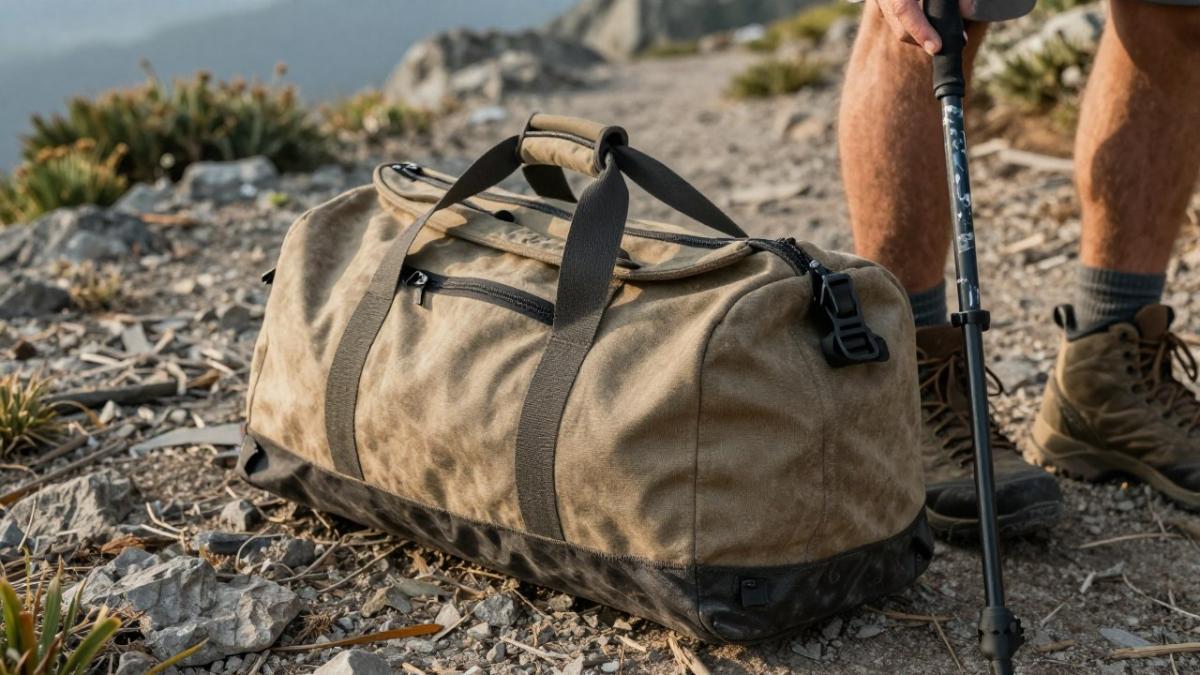
Canvas is a plain-woven fabric, usually cotton or a cotton blend, characterized by heavy weight and high durability. Waxed canvas adds a wax coating that improves water resistance and develops a patina with use. Canvas is abrasion-resistant and repairable, and it ages in a way many travelers prefer. The trade-offs: it is heavy, it can absorb water if unwaxed, and waxed canvas requires re-waxing to maintain water resistance. Canvas is a strong choice for weekend bags and duffels that will be handled roughly but not carried long distances.
How the materials compare in practice
| Material | Weight | Abrasion resistance | Water behavior | Care | End of life |
|---|---|---|---|---|---|
| Recycled polyester (rPET) | Light | Good | Water-resistant with coating; dries fast | Machine washable; avoid high heat | Recyclable in some textile programs; sheds microfibers |
| Organic cotton | Medium | Fair | Absorbs water; slow to dry | Gentle wash; air dry | Biodegradable |
| Canvas (cotton or blend) | Heavy | Very good | Absorbs water unless waxed; wax needs reapplication | Spot clean; re-wax waxed canvas | Biodegradable if untreated; repairable |
The care and end-of-life angle competitors skip
A material's impact depends on how you care for it. Washing a synthetic bag frequently shortens its life and releases microfibers; spot cleaning and air drying extend both. Cotton and canvas should be air dried and stored dry to prevent mildew. At end of life, cotton and untreated canvas can biodegrade, while recycled polyester is recyclable only through textile take-back programs that are still limited.
Our Art By Earth duffel bags use 100% polyester Oxford canvas. Each duffel features a black, adjustable strap with a shoulder pad and a name tag sewn inside, and is available in small and large sizes.
Lifecycle Impact, Repair and End-of-Life Options
A bag's environmental impact covers its whole life, from raw materials through disposal. Before you buy, check whether the brand offers repairs.
Art By Earth Travel Bags for Eco-Conscious Adventurers
Art By Earth designs travel gear for people who care about nature. Our collection includes duffel bags priced at $55.10 each, available in several colors including Black, Blue, Pink, White, and Brown/Beige, and a hard-shell Z suitcase at $241.55. Every duffel is assembled in the USA from globally sourced parts. We are committed to supporting charities dedicated to environmental protection. Explore the full line of eco-friendly duffel bags and the hard-shell Z suitcase to find the fit for your next trip.


Choosing Your Next Sustainable Travel Bag
The right bag depends on your trips, your budget, and how long you want it to last. Start with the durability checks above, match the size to your airline's limits, and favor clear material disclosure. If you want to understand the broader footprint of products like these, read our guide on the environmental impact of art production, or browse our ethical nature-inspired lifestyle accessories and nature themed lifestyle accessories review for more options.
| Bag Type | Starting Price (USD) | Best For |
|---|---|---|
| Art By Earth Duffel Bag | $55.10 | Gym, day trips, mobile storage |
| Art By Earth Z Suitcase | $241.55 | Structured, long-trip travel |
Buy the most durable bag you can justify, and care for it.
Frequently Asked Questions
What materials make a travel bag truly sustainable?
A bag is more sustainable when its materials are recycled, responsibly sourced or made to last for years. Recycled polyester, often made from post-consumer plastic bottles, reduces demand for virgin fossil-based fiber. Organic cotton and canvas can also be good choices when grown without synthetic pesticides. Durability matters as much as material, because a bag replaced every season carries a higher environmental cost than one used for a decade. Look for specific material descriptions and third-party certifications rather than vague claims about being eco-friendly.
Are recycled plastic travel bags actually durable?
They can be, but durability depends on fiber weight, weave density, coating and hardware more than on whether the fabric is recycled. A tightly woven recycled polyester with a water-resistant coating, reinforced stitching at stress points and quality zippers can handle heavy use. Check the listed material and construction details before buying. The Art By Earth duffel bag, for example, is made from 100% polyester Oxford canvas with an adjustable strap and shoulder pad, and its size tolerance is listed as 0.5 inches (1.3 cm).
Do sustainable luggage brands offer lifetime warranties?
Warranty terms vary widely, so read the policy before assuming coverage. Some brands offer repairs or replacement for manufacturing defects, while others offer more limited protection. A warranty is most useful when it covers zippers, handles and wheels, the parts that typically fail first. Ask whether replacement parts are available after the warranty expires, since that determines whether a bag can be kept in use for years.
Are there non-toxic options for travel bags?
Non-toxic is a broad term, so focus on specific materials and disclosed finishes. Polyester and cotton-based fabrics are common in travel bags, and the main questions are which dyes, coatings and flame retardants were used. Ask the seller for a written material breakdown. Art By Earth lists its duffel bags as 100% polyester Oxford canvas, and its suitcase as a polycarbonate front and ABS back hard shell with a removable inner lining.
